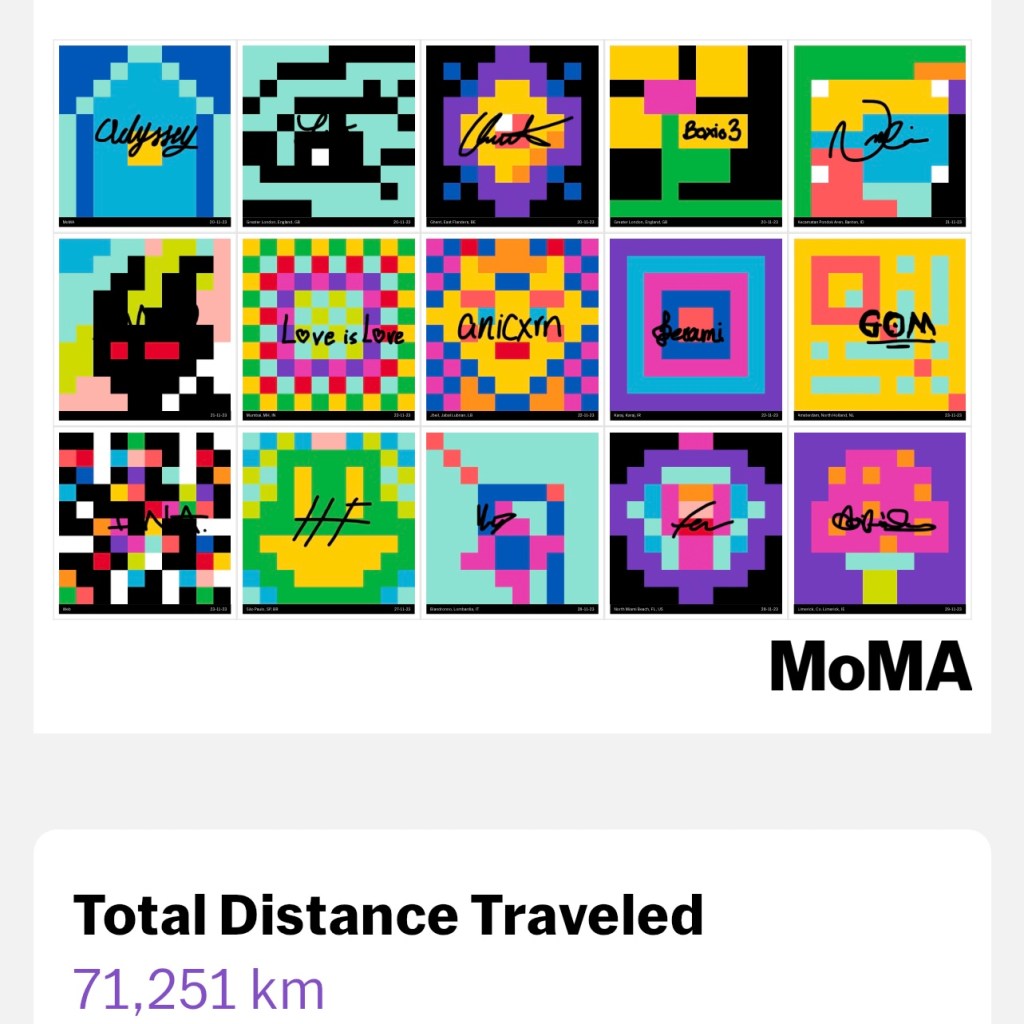
Why This Changes Everything for Digital Art
For years, one question echoed quietly — sometimes loudly — across crypto art spaces:
“Wen MoMA?”
It wasn’t a joke. It wasn’t about validation for ego’s sake. It was about something deeper:
institutional recognition from one of the most conservative, canon-defining forces in modern art.
And now, the answer is no longer hypothetical.
MoMA is here.
The Museum of Modern Art has officially acquired 8 CryptoPunks and a complete set of 8 Chromie Squiggles for its permanent collection, donated collectively by a group of cryptonative collectors.
Let’s be very clear:
this is not a press-friendly experiment, a tech sidebar, or a “digital corner.”
This is canon.
Why This Matters (If You Come From the Traditional Art World)
If you’ve worked with galleries, museums, curators, or acquisition committees, you know how slow institutions move — and for good reason. Museums like MoMA don’t chase trends. They define them retroactively.
Acquisitions go through layers of scrutiny:
- historical relevance
- artistic innovation
- cultural impact
- long-term significance
For decades, digital art has struggled here. Not because it lacked quality, but because it didn’t fit the old frameworks of ownership, conservation, and legitimacy.
NFTs changed that — not overnight, and not without resistance — but structurally.
This acquisition isn’t about pixels or price tags.
It’s about recognizing a new artistic paradigm.
CryptoPunks and Squiggles aren’t being collected as “NFTs.”
They’re being collected as foundational works of 21st-century digital culture.
The Quiet Shift That Made This Possible
One detail matters more than headlines:
Ryan Zurrer — a digital collector — joined the MoMA board.
That alone is historic.
Institutions don’t change from the outside. They change when the people inside understand the language of what’s emerging. This wasn’t a loud announcement. It was a structural move.
From there, conversations shifted from “Will they get it?” to “How do we place this correctly in history?”
And MoMA didn’t rush.
They waited.
They observed.
They watched the community prove — over years — that this wasn’t noise.
Here is a tweet I bookmarked from 2023 when MoMA first started publicly showing an interest on NFTs:
A Collective Gift, Not a Trophy
Another crucial point:
This wasn’t one billionaire collector flexing power.
This was a collective donation — a group of cryptonative collectors contributing works from their personal collections to a public institution.
That matters.
It reflects something the traditional art world often forgets:
movements are built collectively, not individually.
This wasn’t about who owns the rarest Punk.
It was about acknowledging a shared cultural effort that started long before museums paid attention.
If you were here in 2021 or earlier — advocating, educating, minting, collecting, supporting artists — this moment includes you.
Not symbolically. Historically.
What Comes Next (And Why This Is Just the Beginning)
MoMA acquisitions are rarely endpoints. They’re foundations.
- In January, the Node Foundation opens with a major CryptoPunks exhibition.
- A dedicated MoMA exhibition is likely not a question of if, but when.
- And once one major institution moves, others follow — quietly at first, then all at once.
This is how art history has always worked.
The difference now is that for the first time, digital artists and collectors didn’t need to ask permission to exist. They built first. Institutions followed.
We Did It!
As someone who comes from the traditional art world, I can say this plainly:
This acquisition changes the conversation permanently.
Crypto art is no longer “emerging.”
NFTs are no longer a side note.
Digital-native works are no longer waiting outside the museum doors.
They’re inside.
Catalogued.
Preserved.
And written into history.
MoMA didn’t just say yes to Punks and Squiggles.
They said yes to an entire generation that refused to wait.
And there’s no going back.


 FER CAGGIANO
Leave a comment