
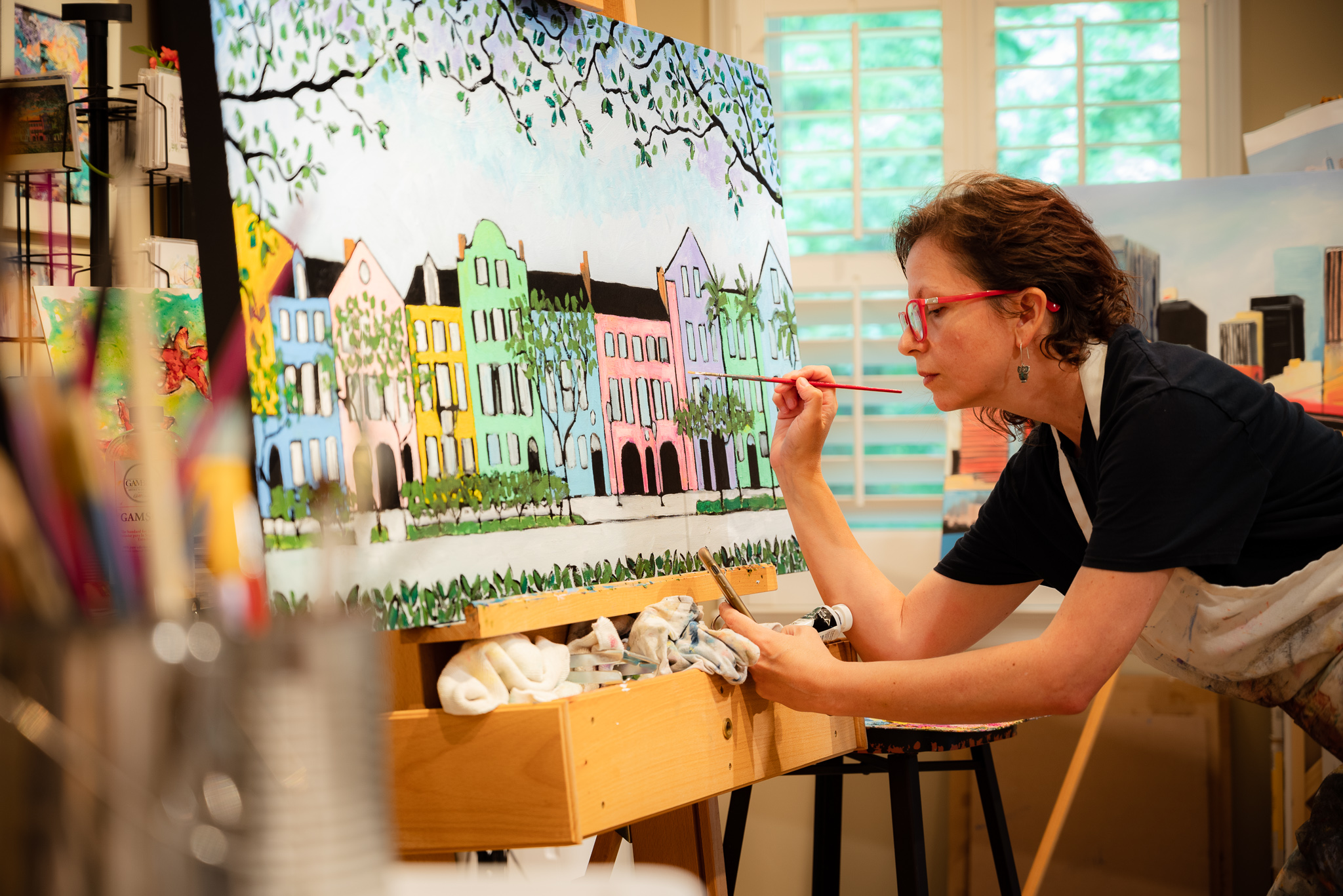


Same face, different tools, and quite a few different lives.
Artists are often told to pick a lane: one medium, one look, repeated until people can recognize your work from across the room. I get it. It works, and it sells.
I chose creative freedom instead. I’m more interested in expressing an idea than in repeating a look, so each piece starts with something I want to say, and only then do I decide how to say it. Painting is the base of everything I do, but when an idea needs a camera, an animation, a video or a few pages of text, that’s what I pick up.
The tools have changed a lot over the years, and so have I. This page follows the work from my first oils in New York to the studio I’m building now in Itupeva, Brazil.
Early Days
I spent years convincing myself that art wasn’t a practical career, so I studied marketing instead.
When I finally got to the Art Students League in New York, I felt I had to make up for lost time. I painted every day, worked on three canvases a week, and showed whenever I could. Those early oils are colorful, physical and full of people, with figures that take up the whole canvas.


Dark Period
A few years later we moved to London, and the work changed along with my life. The colors were still there, but the tones got darker and the faces more restless.
I wasn’t consciously painting what I was going through. It found its way onto the canvas anyway.


The Inward Turn
Back in São Paulo, I started a long period of soul searching, and the paintings followed me there. They became symbolic, almost theatrical, full of flowers, patterns and bodies in meditation.
I was no longer painting what I saw in the mirror, but what I was looking for.


The Long Wait
Then, for almost ten years, I barely touched a canvas. I spent four years as a resident artist at a Buddhist temple, and after that I made a living painting murals in kids’ rooms, living rooms and restaurants. Not exactly the artist’s life I had imagined in my twenties, but an honest one, and always with a brush in my hand.
Whenever I could, I painted for myself on scraps of wood with leftover wall paint. Those pieces became Janelas, a small solo show in 2015.


Back to Art
When I moved back to the United States, I started painting seriously again, and for a while everything fell into place. Charleston gave me its streets, its marshes and that golden Lowcountry light, and I painted a lot of it.
But the work soon started asking for more than beauty. I painted forty women who dared to become themselves, a hive of bees to talk about the pollinators we’re losing, and a love letter to Brazil that helped fund a reforestation project.

Like A Girl: Dare To Dream
Forty portraits of women from all walks of life. Solo show at the City Gallery, 2021.
See the series →
The Hive
Bees, pollinators, a bee costume at the opening, and my very first NFTs. 2021.
See the series →
Saudade
Brazil, painted from far away. It led me to sponsor a reforestation project. 2019.
See the series →
Charleston Mandalas
The little details of Charleston we walk past every day.
See the series →Landscapes & watercolors


Digital & Beyond
Around 2021, life changed again, and so did my tools. I picked up an iPad, and it opened up a kind of freedom I hadn’t had before.
Suddenly I could animate a painting, change its colors and proportions, and try ten versions of the same idea. Then my photographs started to move, and eventually I even started painting with code.

Digital paintings & NFTs
Digital paintings and animations, shown and collected around the world.
See the work →
Still, Not Still.
Photographs I paint over, frame by frame, until they start to move.
See the series →
Generative art
Art written in code, where each piece finds its own shape. Flow, Patterns and what comes next.
See the projects →Now
Today I’m back in Brazil, building a studio in Itupeva and going back to canvas, texture and paint on my hands.
I’m not leaving digital behind, though. I’m just still using whatever the idea asks for.


Not only paint
Painting is the base. It was never the limit.
Some ideas need a brush. Others need a lens, or a few thousand words.

Painting
Canvas, paper and whatever paint the idea needs. The base of everything I do.
See the paintings →
Photography
From my Nikon to my phone, framing what’s already there. I also edit my own videos, mostly for YouTube and Instagram.
See the photographs →
Writing
My blog, and a book I’ve been writing slowly, one memory at a time, with no rush to finish.
The book → The blog →Illustration
Two books I illustrated
Both came out in 2020. Neither one is for sale right now, but they belong with the rest of the work, so here are a few pages of each.

The Girl Who Didn’t Like Christmas
A children’s book written by Fernanda Nilson, about a five-year-old who thinks she doesn’t like Christmas. Forty illustrated pages. 2020.
Leaf through 8 spreads →
Endangered Species Coloring Book
Twenty endangered animals drawn for coloring, from the rusty patched bumble bee to the red wolf, with descriptions by Diane Fletcher. 2020.
Leaf through 8 pages →Artist statement
Using art as a voice for the greater good.
Art can create a shift in mindset. If a person is uneasy, art can bring peace. If someone feels stagnant, art can make them move. I see a painting as a portal, one that can take you to a quieter place or push your mind toward new ideas.
For me, art is meant to start conversations. It can raise awareness, help us search for meaning, and give us a way to look inside ourselves.
That’s why so many of my projects support causes I believe in, like equality and environmental sustainability.
The face changes, and the medium certainly does. The idea still leads the way.