NFT Platforms Are Closing — What’s Really Happening?
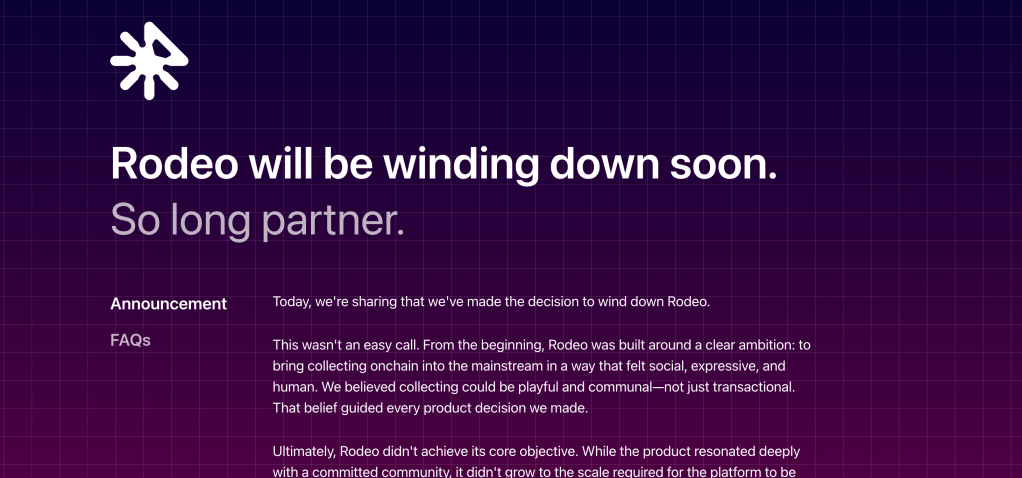
Over the past months, several NFT platforms have announced their closure. This week, I personally moved the NFTs I had collected from Nifty Gateway, and I’m currently wrapping up with another platform, Rodeo.
Each time this happens, the same conclusion appears: NFTs are dead.
But that conclusion usually comes from looking at NFTs as a market trend — not as a medium for art.
From an artist’s perspective, what’s happening right now looks very different.
The Problem Was Never the Art
Most NFT platforms that are closing were built during a time of intense hype. NFTs were treated primarily as speculative assets, designed to be traded quickly rather than understood slowly.
Art existed on these platforms, but it wasn’t always the focus.
When these platforms disappear, the art doesn’t disappear with them. What disappears is the infrastructure that depended on constant attention, rapid trading, and endless growth.
Why Ownership and Provenance Matter
One reason I never fully embraced certain platforms is that artists didn’t truly control their own work. The platform managed the contracts, the minting process, and ultimately the long-term access to the artwork.
That may sound technical, but the idea is simple:
If the artist doesn’t control how their work is created and stored, the work is vulnerable.
When NFT platforms shut down, that vulnerability becomes obvious. For NFT art to hold cultural value over time, ownership and provenance must stay with the artist.
When Discovery Is Fun — and Distracting
Some platforms genuinely improved artist discovery. Rodeo, for example, made it easy to find new artists and collect meaningful work. I loved my time there and discovered pieces I still care deeply about.
At the same time, the platform encouraged fast experimentation. I noticed myself publishing more ideas and fragments, and fewer resolved works.
This isn’t a flaw — it’s a design choice. Every platform shapes artistic behavior. Over time, I had to ask whether that pace supported the kind of practice I wanted to sustain.
The Hidden Cost of Visibility for Artists
Other ecosystems, like Tezos, became spaces where artists primarily collect and support one another. That generosity is powerful, but visibility is hard to achieve.
Minting work alone isn’t enough. Artists must constantly share on social media to be seen. I’ve never enjoyed promotional messaging or spamming people, and when my social media reach declined, visibility disappeared with it.
This raises an uncomfortable question:
How much time should artists spend marketing themselves instead of making art?
Are NFTs Still Relevant as Art?
The Museum of Modern Art (MoMA) has included NFTs in its collection for some time, but recent acquisitions — formally accepted and curated by the museum’s board — marked a turning point.
Museums don’t collect hype. They collect movements.
This matters because it confirms that NFT art is not just a market experiment. It has entered contemporary art history.
Speculation has largely moved on to gaming, tokens, and fast financial products. What remains for artists is quieter, slower, and more intentional.
What Artists Should Consider Moving Forward
Recently, I was asked a common question: Where should artists mint NFTs today?
There is no single answer anymore.
More important questions are:
- Do I control my artwork?
- Am I prioritizing visibility or depth?
- Will this work still make sense years from now?
NFTs didn’t fail. The hype did.
What remains is a tool — imperfect, evolving, but still capable of supporting meaningful artistic practice. The difference now is that artists must be deliberate.
And perhaps that’s what maturity looks like — for the technology, and for us.
Note for Web3 readers: I’ve published a longer, more technical version of this article on Paragraph, aimed at artists and collectors already working inside Web3. If that’s you, you may find the additional context useful.

 FER CAGGIANO
Leave a comment